UPI Charges Above ₹2,000 From October 2026? Here’s What You Will Actually Pay
UPI is not becoming paid for customers. A new 0.4% MDR will apply to selected merchant payments above ₹2,000 from October 15, while P2P transfers and most everyday UPI payments remain free.
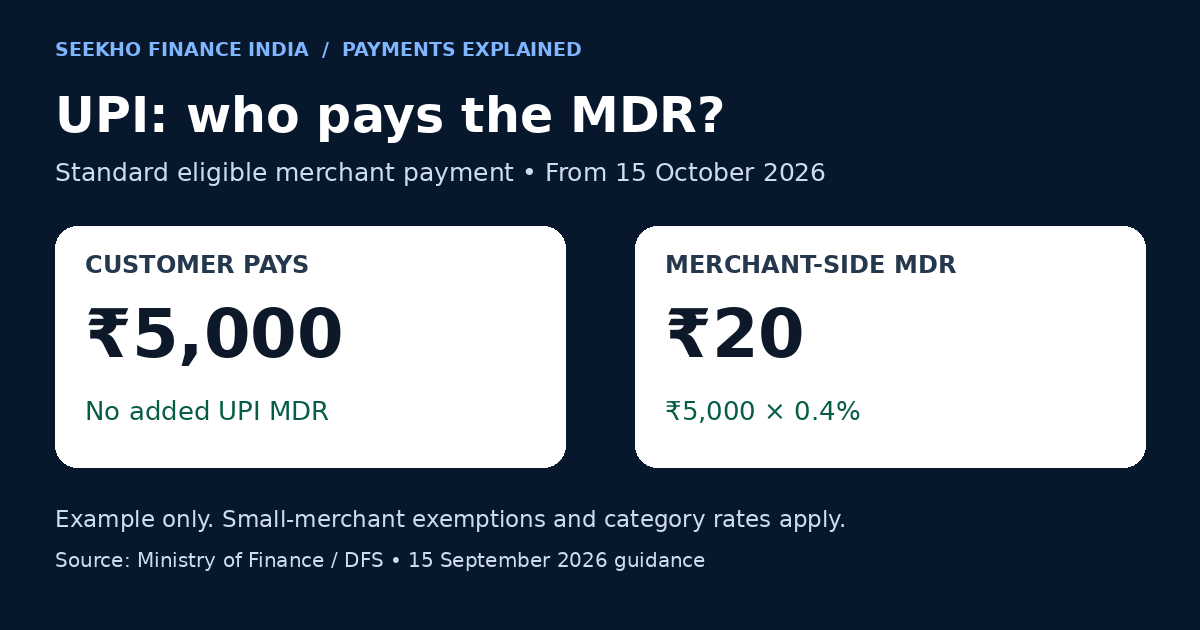
Illustrative standard eligible merchant payment from 15 October 2026. Exemptions and special category rates apply; MDR is not added to the customer’s bill.
If you've read headlines talking about "UPI transactions above ₹2000 will now be charged", you may well be wondering "if paying ₹5000 via PhonePe or Google Pay will suddenly cost me extra". The short answer for an ordinary UPI user is that you won't be charged extra just because you pay more than ₹2000. You'll still be able to send ₹5000 to your brother for free with any UPI app.
What is changing is how certain kinds of merchant UPI payments are funded behind the scenes. Starting October 15, 2026, a Merchant Discount Rate, or MDR, of 0.4% will now apply to specified person-to-merchant UPI payments above ₹2000. The MDR will be borne inside the merchant's payment ecosystem, not by the customer making the payment. Person-to-person transfers will continue to be free regardless of amount.
So if you send ₹20,000 to your brother using UPI, the new MDR won't apply. ₹5000 paid to a qualifying large merchant with UPI could incur an MDR on the merchant, but the government says that the merchant cannot simply add that as a UPI fee to your bill. Banks have been instructed to ensure that such costs aren't pushed straight to the customer, and UPI apps are forbidden from levying platform fees or hidden transaction charges under this scheme.
That sounds simple enough, but new framework includes layers. Small shops are protected, some industries only pay ₹5 per transaction, capital-market payments have a much lower rate, and huge transactions have an MDR cap. Here is what is actually changing.
What Has Changed With UPI?
Until recently one of UPI's biggest advantages was its zero-MDR structure for regular bank-account-based payments. A customer could pay a merchant through UPI and the latter would generally receive the full transaction amount without the type of Merchant Discount Rate that is associated with cards.
The government had earlier prohibited MDR on UPI merchant transactions, which has helped UPI scale rapidly across everything from street vendors and kirana shops to major retailers. In August 2026 alone UPI processed around 2,451 crore transactions worth ₹29.9 lakh crore, indicating how deeply the payment system has been embedded into India's economy.
The official September 15 guidance explains a limited merchant-funded model, with exemptions intended to protect consumers and small merchants.
The new framework follows deliberations through the UPI Steering Committee. The standard rate has been set at 0.4% for eligible person-to-merchant transactions above ₹2,000, subject to several exemptions and caps.
Does This Mean UPI Users Will Pay a Fee?
No.
For most people using UPI, the payment experience should remain the same.
The Finance Ministry has explicitly said that all person-to-person UPI transactions will continue to remain free, irrespective of the amount transferred. This means sending ₹500 to a friend, ₹10,000 to a family member or a larger eligible transfer to another individual's bank account does not attract this MDR.
Customers also do not pay the MDR when making a merchant payment. The MDR is charged within the merchant-payment ecosystem and is distributed between participants involved in processing the transaction, including banks, payment service providers and UPI app providers.
That means the new framework should not work like this:
You buy something for ₹5,000.
Merchant says: “UPI charge is ₹20 extra.”
You pay ₹5,020.
The government says merchants are not permitted to pass the MDR on to the customer in that manner, and UPI apps cannot introduce hidden platform fees under the new framework.
Your ₹5,000 purchase should therefore still cost you ₹5,000.
The merchant's payment provider handles the applicable MDR separately
Then What Exactly Is MDR?
MDR stands for Merchant Discount Rate.
It is essentially a payment-processing charge associated with accepting certain forms of digital payment.
If you have ever wondered why some businesses historically preferred cash over credit cards, MDR was one reason. When a customer pays using a card, the merchant may pay a small percentage of the transaction to the payment ecosystem.
That fee is then distributed among the different companies involved in completing the payment.
UPI operated differently for years because the government maintained a zero-MDR policy for bank-account-based UPI merchant payments.
The new rule introduces a limited version of MDR into UPI.
For regular eligible merchant transactions above ₹2,000, the rate will be:
0.4% of the transaction value.
For transactions of ₹75,000 and above, the MDR will be capped at ₹300.
How Much MDR Will Apply? Some Simple Examples
Illustrative standard eligible merchant payments from 15 October 2026; category exemptions may change the rate.
Purchase amount
Customer pays
Merchant-side MDR
₹2,000
₹2,000
₹0
₹3,000
₹3,000
₹12
₹5,000
₹5,000
₹20
₹50,000
₹50,000
₹200
₹75,000
₹75,000
₹300
₹1,00,000
₹1,00,000
₹300
Suppose you pay a qualifying merchant ₹3,000 using UPI.
At 0.4%, the applicable MDR would be:
₹3,000 × 0.4% = ₹12
You still pay ₹3,000.
The ₹12 is the merchant-side payment cost.
Now suppose the bill is ₹50,000.
₹50,000 × 0.4% = ₹200
Again, you pay ₹50,000. The merchant side bears the ₹200 MDR.
At ₹75,000, a 0.4% calculation produces ₹300.
That is also where the cap begins.
If the transaction is ₹1 lakh, the normal 0.4% calculation would produce ₹400, but the MDR does not keep increasing. It is capped at ₹300 for transactions of ₹75,000 and above. The official government FAQ examples use the same structure: ₹3,000 results in ₹12 MDR, ₹50,000 results in ₹200, and transactions of ₹75,000 or more are capped at ₹300.
What Happens to Payments Below ₹2,000?
Nothing changes for them.
All qualifying person-to-merchant UPI payments of ₹2,000 or less remain at zero MDR.
This is important because smaller transactions form the overwhelming majority of merchant UPI payments.
The government estimates that roughly 96% of merchant UPI transactions will remain unaffected by the new MDR framework because they either fall below the ₹2,000 threshold or qualify for other exemptions.
That means buying tea for ₹20, paying ₹600 at a restaurant, spending ₹1,500 at a pharmacy or paying ₹2,000 to a retailer should not create an MDR charge under the new rules.
The change is aimed primarily at larger commercial transactions rather than the small daily payments through which most Indians use UPI.
Small Merchants Get Another Important Exemption
The ₹2,000 limit is not the whole story.
The new framework also protects small merchants such as neighbourhood shops and street vendors.
Small merchants receiving up to ₹1 lakh per month through UPI QR payments under the P2PM category will continue to receive zero-MDR treatment on qualifying transactions. The Finance Ministry says this protection is intended to prevent small businesses and street vendors from carrying additional payment-processing costs.
This distinction is important because otherwise headlines saying “UPI above ₹2,000 will cost merchants 0.4%” can also be misleading.
Not every ₹2,001 merchant payment suddenly generates MDR.
Merchant category and the applicable exemption matter.
What About Petrol Pumps?
Petrol pumps are treated differently.
For fuel transactions above ₹2,000, the merchant does not pay the standard 0.4% MDR. Instead, the new framework provides a flat ₹5 MDR per transaction.
That means if you pay ₹4,000 for fuel using UPI, the applicable merchant-side charge is ₹5 rather than ₹16.
If you pay ₹6,000, it remains ₹5 rather than ₹24.
Transactions at or below ₹2,000 remain zero MDR.
The idea is to avoid placing a percentage-based fee on businesses where margins can already be narrow.
Railways, Telecom and Insurance Also Get a ₹5 Rate
The same flat structure applies to several other essential or thin-margin sectors.
The Finance Ministry lists categories including railways, telecommunications, insurance, fuel and agricultural inputs as qualifying for a flat ₹5 MDR on applicable transactions above ₹2,000.
This means the merchant-side economics of paying a ₹20,000 insurance premium through UPI are very different from buying ₹20,000 worth of goods at a standard commercial retailer.
The government has designed different MDR rates based on the type of payment rather than applying one 0.4% fee across every merchant category.
What About Electricity and Other Utility Bills?
Public utilities are also intended to receive concessional treatment.
The government’s published FAQs state that utility payments such as electricity, municipal water and piped gas above ₹2,000 fall under a designated category where a flat ₹5 MDR can apply instead of the standard percentage rate. Payments at or below ₹2,000 remain free of MDR.
For customers, again, this does not mean adding ₹5 to the electricity bill because UPI was used.
The fee sits on the merchant-processing side.
What About Mutual Funds and Stock Market Payments?
This is particularly relevant for investors who use UPI for one-off mutual fund payments or other eligible market-linked transactions.
Capital-market transactions receive a much lower MDR.
Payments involving mutual funds, securities, stockbrokers and dealers will attract an MDR of 0.02%, capped at ₹300 per transaction.
The difference is substantial.
A standard ₹50,000 commercial merchant payment at 0.4% would generate ₹200 MDR.
A qualifying ₹50,000 capital-market payment at 0.02% works out to ₹10.
The lower rate is intended to limit payment friction for retail participation in formal financial markets.
What about AutoPay and credit-linked UPI?
The official FAQ on recurring payments excludes automated standing instructions such as AutoPay from these prescribed MDR charges. Credit-card-linked UPI and credit lines follow separate product rules. Do not apply the standard merchant-payment examples to those products.
Will Sending ₹10,000 to a Friend Cost Anything?
No.
This is probably the simplest test for understanding the new rule.
If you were to transfer ₹10,000 from your bank account to your friend's personal UPI ID, that would be a person-to-person transaction.
No MDR applies.
Similarly, if you pay ₹50,000 to your parents via UPI, there would be no MDR under this framework.
Same for a personal ₹25,000 received.
The Finance Ministry says that transactions of this nature (P2P) would continue to be outside the purview of the new charges framework regardless of value.
Which means that ₹2,000 is not a cap on free transfers via UPI.
Probably the biggest misinterpretation of the announcement.
Normal bank and NPCI transaction limits still apply. These limits are safeguards, not thresholds that trigger a customer fee.
Will PhonePe or Google Pay Start Charging Me?
Not under this MDR framework.
Applications such as PhonePe, Google Pay and Paytm are part of the UPI payment ecosystem, and the new MDR creates a commercial revenue pool that can be distributed among participating entities.
But that is different compared to charging the customer directly.
The government says that UPI application providers are prohibited from imposing platform fees or hidden charges on ordinary consumers under this framework.
So if you pay ₹5,000 to a qualifying merchant by using Google Pay, PhonePe or another UPI app, the application should not add a separate consumer UPI transaction fee just because the payment crossed ₹2,000.
The commercial settlement takes place behind the transaction.
Why Introduce MDR Now?
UPI has scaled to such a level that it is now extremely expensive to operate.
In August 2026 alone, the network has processed about 2,451 crore transactions worth ₹29.9 lakh crore. This requires an army of systems, infrastructure, data centers, network security, fraud checks, customer support and constant technology upgrades. In addition, the government has long-term subsidies for the zero-MDR model, which has helped drive its success.
The main issue is that payment networks are not free to operate, even if the end-user does not pay any fee.
The government's argument is that a limited MDR model will help the ecosystem invest in infrastructure, security and customer support, while keeping the consumer payments free.
Under the new model, MDR revenue is shared among payment ecosystem participants; it is a commercial processing charge, not a tax paid to the government.
Is the UPI MDR a New Tax?
No.
The Finance Ministry explicitly says the MDR is not a tax and is not collected by the government or NPCI as tax revenue.
It is a commercial payment-processing charge distributed among the participants that operate and support UPI transactions.
MDR should not be confused with GST: a payment-processing charge and a tax are different things.
The current change is about MDR on specified merchant transactions, not a 0.4% tax on consumers.
Why ₹2,000?
The threshold seems to be designed to preserve the zero-cost proposition for the everyday payments that created the UPI success story, while opening up the scope for the ecosystem to make money on larger commercial payments.
Government data shows that over 95% of merchant UPI transactions by number are at or below ₹2,000, which suggests most everyday payments will remain untouched. Imposing a MDR on even a small percentage of these would disincentivize adoption of UPI by smaller players: that is what this structure seeks to avoid.
The new structure attempts to differentiate between the high-volume everyday payments and larger commercial payments.
Why Would Banks and Payment Apps Want MDR?
Running UPI is simply not free for banks or payment companies.
While a transaction may seem simple to the customer, there are various underlying systems working in the background. The payer’s bank needs to authenticate and debit their account, the merchant’s bank needs to receive it, the payment service providers need to maintain interfaces, NPCI needs to run switching infrastructure and companies need to spend money on fraud detection, security and customer support.
With a completely zero MDR model, these costs need to come from somewhere.
A predictable revenue stream from merchant payments creates a stronger commercial incentive for banks and fintech companies to continue investing in UPI.
The commercial attraction is a recurring source of funding for banks and payment providers. Actual revenue will depend on eligible transaction volumes and merchant classifications; a headline forecast should not be treated as guaranteed income.
Could Merchants Increase Prices Anyway?
This is where it gets interesting.
The rules prohibit merchants from passing on the MDR as a direct surcharge to the customer via a UPI surcharge.
But the economics of any operating cost is likely to get folded into the overall economics of a business.
A big merchant, processing millions of rupees worth of payments via UPI, would find itself facing a payment cost that might not have been there earlier. Some businesses will internalize this cost since UPI is a much cheaper medium than other payment instruments or simply because it is inconvenient to refuse UPI.
Meanwhile other businesses can rework their product pricing to internalize higher operating costs.
That would not be the same as demanding 0.4% extra for using UPI which is prohibited under the framework.
But how that will play out in practice is something to watch out for in October.
Will Shops Start Asking for Cash Again?
For most small merchants, probably not because the new framework specifically protects them.
UPI remains attractive because it is instant, widely used and removes much of the hassle associated with cash collection.
Even among larger merchants subject to MDR, the 0.4% standard rate is still relatively low compared with many traditional card-payment charges.
Businesses also gain from easier reconciliation, lower cash-handling requirements and access to digital transaction records.
The new charge changes the economics of UPI, but it does not remove the reasons merchants adopted it in the first place.
What Happens From October 15, 2026?
From the effective date, the new MDR structure applies to eligible merchant transactions.
For an ordinary consumer, there should be very little to change in day-to-day usage.
You can still scan a QR code.
You can still use PhonePe, Google Pay, Paytm or another UPI app.
You can still send money to people for free.
You can still make ordinary merchant payments without a consumer transaction charge.
The biggest change happens behind the scenes for larger merchants and payment companies.
That is why the headline “UPI is becoming paid” is technically misleading.
A better description is:
UPI remains free for consumers, while selected larger merchant payments are moving from zero MDR to a limited merchant-funded model.
Quick Summary of the New UPI Charges
For person-to-person transfers, the charge is ₹0, irrespective of the amount.
For regular merchant payments up to ₹2,000, MDR remains 0%.
For qualifying regular merchant payments above ₹2,000, MDR is 0.4%.
For transactions of ₹75,000 and above, standard MDR is capped at ₹300.
Small merchants receiving up to ₹1 lakh a month through eligible QR-based UPI payments continue to receive zero-MDR protection.
For sectors such as fuel, railways, telecom, insurance and agricultural inputs, eligible transactions above ₹2,000 have a flat ₹5 MDR.
Capital-market transactions including mutual funds, securities and stockbroking payments have an MDR of 0.02%, capped at ₹300.
And most importantly, the customer making the UPI payment is not supposed to pay the MDR.
Final View
The biggest change to UPI in years is happening, but not in the way many headlines make it sound.
UPI is not becoming a paid service for ordinary users from October 15. Sending money to another person remains free regardless of the transaction value, and customers are not supposed to pay a transaction fee when using UPI at merchants.
The change is on the merchant side.
Selected person-to-merchant payments above ₹2,000 will now attract a 0.4% Merchant Discount Rate, with a ₹300 ceiling for transactions of ₹75,000 and above. Essential categories such as fuel, railways, telecom and insurance receive a flat ₹5 structure, while capital-market payments have their own lower 0.02% rate.
The government estimates that around 96% of merchant UPI transactions will remain unaffected, while all person-to-person payments stay outside the MDR framework.
That leaves us with a fairly simple takeaway.
If you send ₹10,000 to a friend, you do not pay a UPI charge.
If you buy something worth ₹5,000 from a qualifying merchant, you still pay ₹5,000.
The merchant's payment ecosystem may now carry an MDR.
And if someone tells you that “every UPI payment above ₹2,000 now has a 0.4% customer fee,” that is not what the new rules say.
The bigger story is not that UPI has stopped being free for Indians. It is that after years of rapid expansion under a zero-MDR model, India is starting to build a commercial funding model for the infrastructure running behind larger UPI merchant payments.
Sources and verification
Checked against the Ministry of Finance release and government FAQs on 16 September 2026. The announced effective date is 15 October 2026; consult your acquiring bank for merchant classification and implementation details.